 Image 1 of 1
This is the sixth free resource that I am offering on my website. Simply click ‘Add to Cart’, proceed to checkout, provide an email address and billing address, and the resource will be emailed over to you for free.
I thought long and hard about sharing a resource that I developed using AI; I decided to include this to highlight to parents the drawbacks of using AI, as well as the benefits.
As I mention in my ‘Glossary’ resource, AI can produce responses that might look acceptable to parents, but are in practice far too generic to be useful to students. Students are keenly aware of this - and have often pointed out to me the sub-par quality of AI generated resources. Since the original creation of this resource, I have tried to modify it to focus on one key text (for example, An Inspector Calls). In place of completing the task accurately, AI instead ‘ghosts’ quotations, inventing lines that characters never said. Not only this, but it will ‘ghost’ convincingly, giving examples that appear Shakespearean, but are in fact hallucinations.
Nonetheless, with the right amount of teacher input and experience, I was able to generate this simpler resource covering a range of texts without much too much prompting.
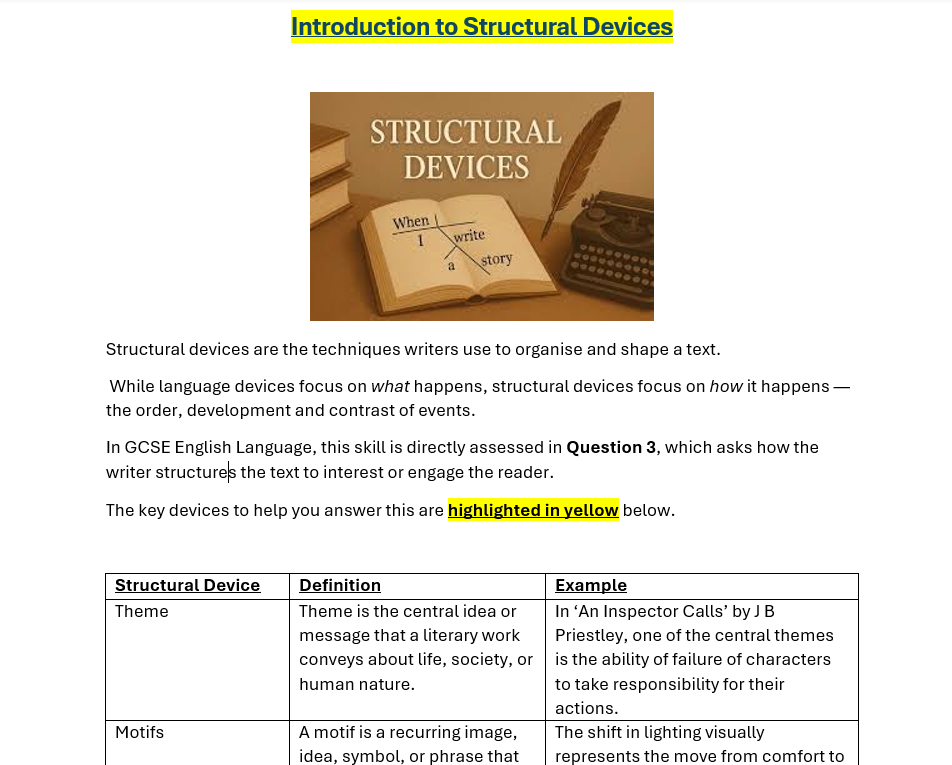
Firstly, I asked it to generate a list of structural terms, definitions and examples, in order to help my students with Question 3 of the GCSE English Language curriculum. This is arguably the most difficult question across the entire GCSE.
Having found the structural terms that AI generated to be too generic, I went through and read the mark schemes of every language paper ever published to build up a wider range of structural terms, before repeating the prompt. For any examples or definitions I wasn’t happy with, I either re-prompted AI or went in and changed the response manually.
The final table attached is the most extensive list of structural terms I know of.
As the Examiner’s Reports point out, it is far more important that students comment on the effects of these methods; however, in my experience, learning the methods by rote is a useful starting point.
This is the sixth free resource that I am offering on my website. Simply click ‘Add to Cart’, proceed to checkout, provide an email address and billing address, and the resource will be emailed over to you for free.
I thought long and hard about sharing a resource that I developed using AI; I decided to include this to highlight to parents the drawbacks of using AI, as well as the benefits.
As I mention in my ‘Glossary’ resource, AI can produce responses that might look acceptable to parents, but are in practice far too generic to be useful to students. Students are keenly aware of this - and have often pointed out to me the sub-par quality of AI generated resources. Since the original creation of this resource, I have tried to modify it to focus on one key text (for example, An Inspector Calls). In place of completing the task accurately, AI instead ‘ghosts’ quotations, inventing lines that characters never said. Not only this, but it will ‘ghost’ convincingly, giving examples that appear Shakespearean, but are in fact hallucinations.
Nonetheless, with the right amount of teacher input and experience, I was able to generate this simpler resource covering a range of texts without much too much prompting.
Firstly, I asked it to generate a list of structural terms, definitions and examples, in order to help my students with Question 3 of the GCSE English Language curriculum. This is arguably the most difficult question across the entire GCSE.
Having found the structural terms that AI generated to be too generic, I went through and read the mark schemes of every language paper ever published to build up a wider range of structural terms, before repeating the prompt. For any examples or definitions I wasn’t happy with, I either re-prompted AI or went in and changed the response manually.
The final table attached is the most extensive list of structural terms I know of.
As the Examiner’s Reports point out, it is far more important that students comment on the effects of these methods; however, in my experience, learning the methods by rote is a useful starting point.