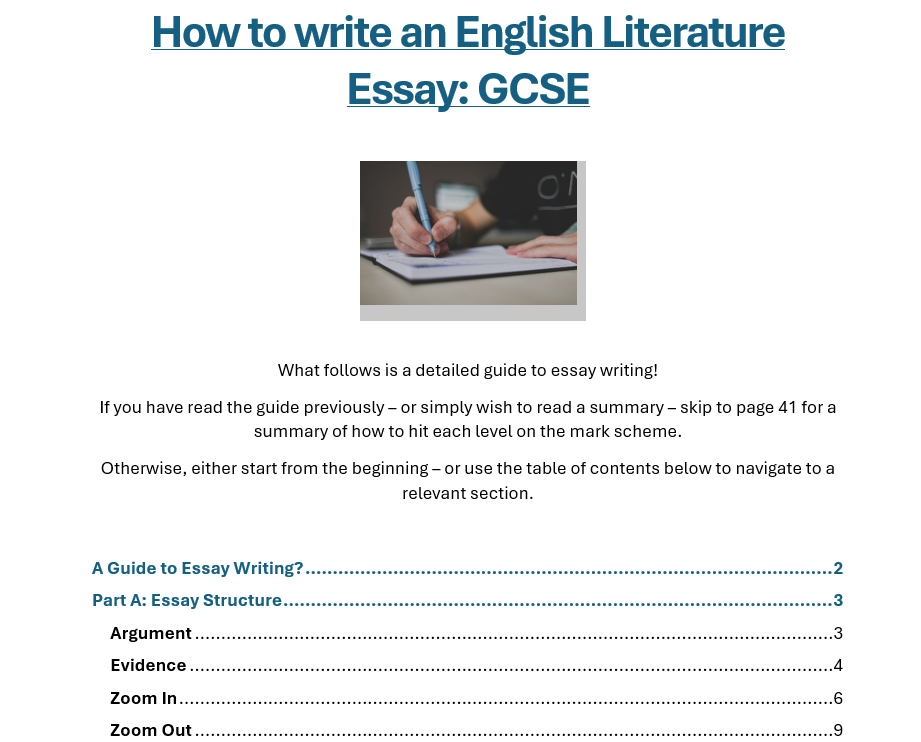
This is the first free resource that I am offering on my website. Simply click ‘Add to Cart’, proceed to checkout, provide an email address and billing address, and the resource will be emailed over to you for free.
This is an extract of a longer document that is around 43 pages long and over 12,000 words. It was written before the era of AI and was shared widely by students and colleagues in my department.
Many of the students I taught had strong backgrounds in science and mathematics, but struggled when it came to English Literature. One of my favourite things in teaching is breaking down difficult concepts (such as essay writing) into their component parts - and this guide was written for the kind of students that needed a scaffold, formula or framework through with to approach English.
Some English teachers have a resistance to this kind of resource, preferring to argue that you cannot ‘teach’ essay writing or break it down into a ‘formula’. There may be some truth to this if you want to go on to study English Literature beyond undergraduate level, but for many students, modelling, sentence stems and scaffolding is precisely what they need - English is no exception to any other subject.
This resource is written to prove to parents and students alike that you can learn how to write an essay, just as you can learn how to solve a quadratic equation or take a free kick!
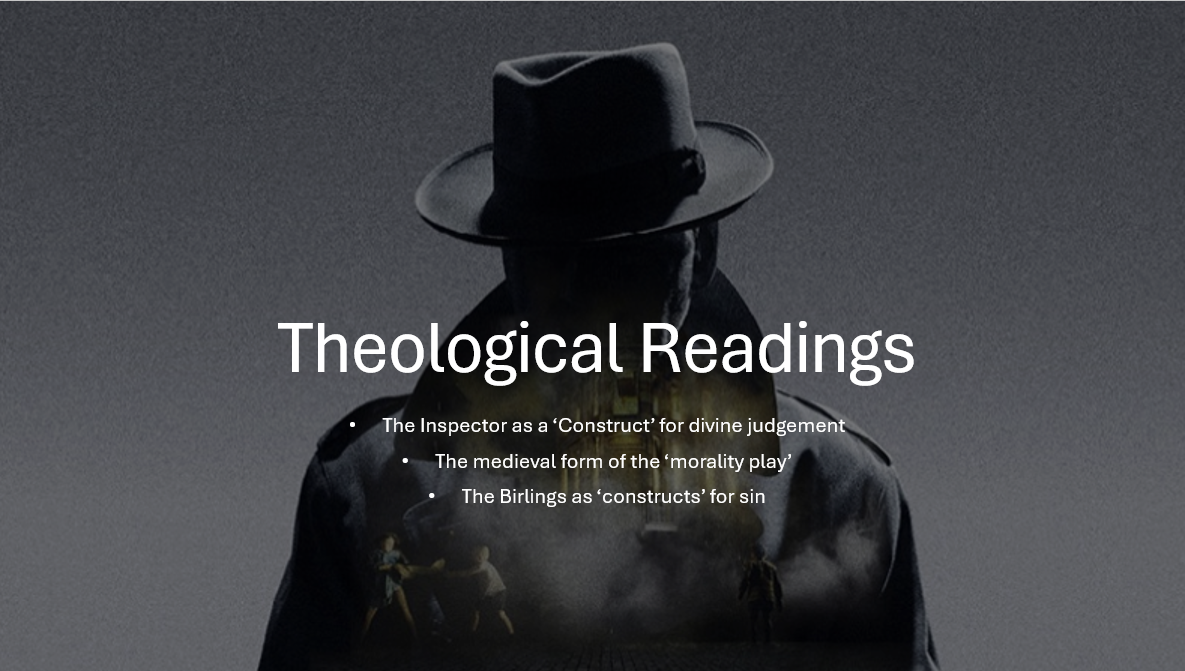
This is the second free resource that I am offering on my website. Simply click ‘Add to Cart’, proceed to checkout, provide an email address and billing address, and the resource will be emailed over to you for free.
This resource demonstrates that I have the capability to stretch and challenge students, moving their responses beyond ‘Clear’ and into the ‘Thoughtful’ and ‘Conceptual’ categories that are at the top end of the GCSE mark schemes.
One of the major issues that students will find with GCSE AQA Literature Paper 2 is that almost every school in the country studies J B Priestley’s An Inspector Calls. Examiners have a 350 script quota and invariably read the same responses over and over again.
These slides form part of a larger Powerpoint that aims to introduce students to material that extends their responses well beyond the usual social and cultural readings of the play. This will help their response stand out from the other 349 scripts that an examiner will be working through as part of their summer quota.
These resources are not AI generated, so any mistakes are my own.
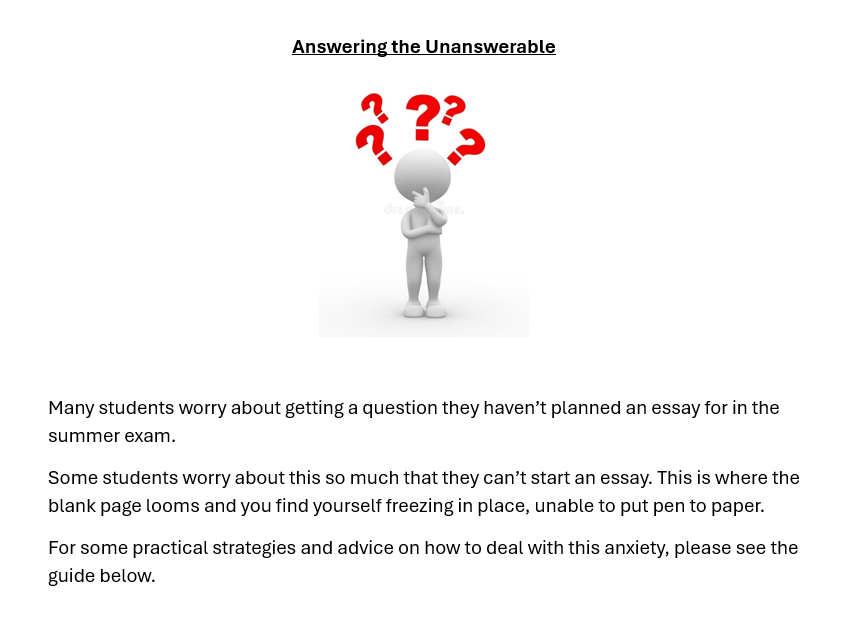
This is the third resource that I am offering on my website. Simply click ‘Add to Cart’, proceed to checkout, provide an email address and billing address, and the resource will be emailed over to you for free.
I had the privilege of teaching the most lovely Year 11 support set at my previous school. One of the things they really challenged me to think about was how to create resources for them that took them through some of the skills I might have taken for granted - in this case, how to answer a seemingly ‘impossible’ essay question.
After a lot of thought, I produced the following document, which I then edited this summer. It takes students through four practical tips, as well as a fifth ‘mindset’ tip, on how to approach a question that students might think they can’t answer.
If your son or daughter has had problems ‘freezing-up’ in English exams, this can have a number of sources and might needs a range of strategies to help, but they might start by reading this guide.
This is the fourth free resource that I am offering on my website. Simply click ‘Add to Cart’, proceed to checkout, provide an email address and billing address, and the resource will be emailed over to you for free.
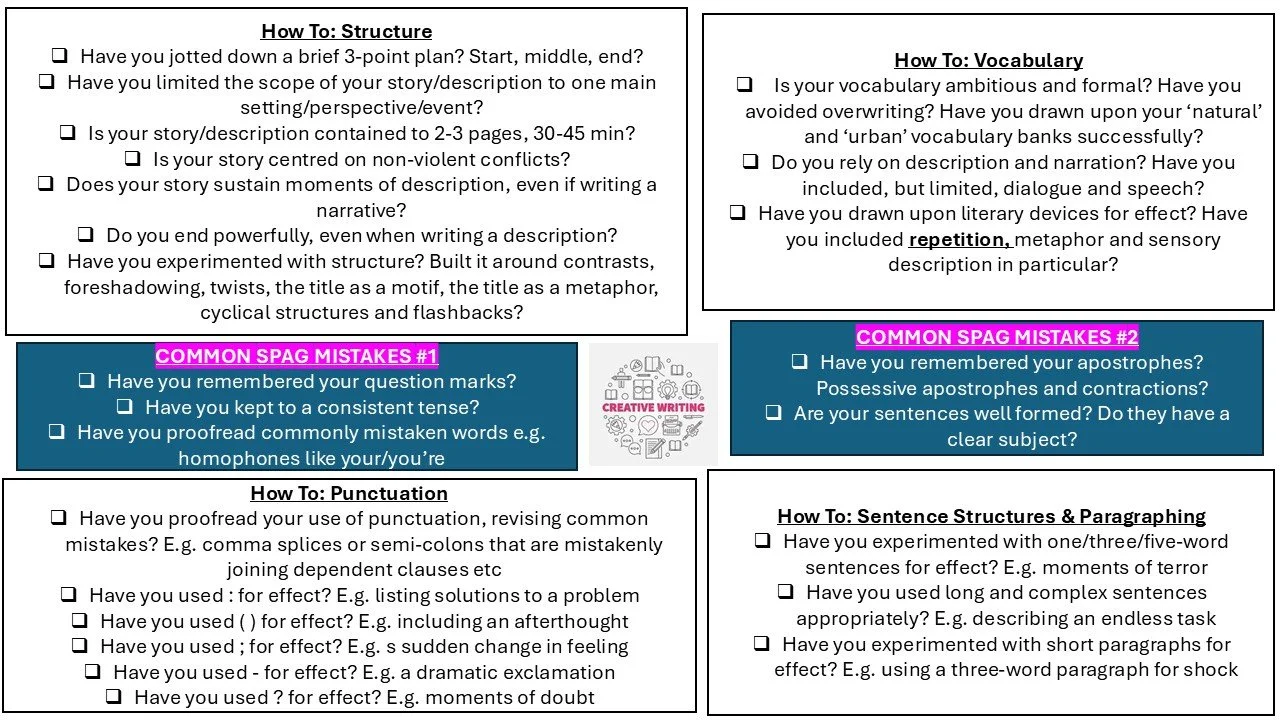
After speaking to a previous Year 11 group, I noticed that they were requesting a check-list of sorts for completing their creative writing. I took the idea of a ‘Crib Sheet’ from another colleague, who had introduced it to their Sixth Form class in a different context.
This resource is a summary resource - unlike my essay writing guide, it is designed to fit onto one slide, which can be projected onto the screen as students write. It is deliberately brief and designed to minimise cognitive overload.
This resource covers some of the common mistakes that students make, as well as things that I have picked up from other creative writing resources. It also contains a range of tips and tricks that I have picked up from my own examining and assessment - some of these techniques I haven’t seen shared elsewhere, but am happy to share free of charge.
This is the fifth free resource that I am offering on my website. Simply click ‘Add to Cart’, proceed to checkout, provide an email address and billing address, and the resource will be emailed over to you for free.
This resource addresses the problem of subject specific vocabulary when writing literature essays. When marking many of the grade 6 to grade 7 literature responses, I noted that they lacked the technical vocabulary of many of the grade 8 and grade 9 literature responses.
I experimented with using ChatGPT and Claude to generate a glossary of vocabulary that would lift the quality of these responses. However, both produced glossaries that were far too generic. As such, I had to address this problem manually. I went through my model bank of high quality responses and pulled out every word or phrase that I felt would lift both the vocabulary and the sophistication of the response that used them.
This glossary covers An Inspector Calls, Macbeth and Jekyll and Hyde.
These resources are not AI generated, so any mistakes are my own.
This is the sixth free resource that I am offering on my website. Simply click ‘Add to Cart’, proceed to checkout, provide an email address and billing address, and the resource will be emailed over to you for free.
I thought long and hard about sharing a resource that I developed using AI; I decided to include this to highlight to parents the drawbacks of using AI, as well as the benefits.
As I mention in my ‘Glossary’ resource, AI can produce responses that might look acceptable to parents, but are in practice far too generic to be useful to students. Students are keenly aware of this - and have often pointed out to me the sub-par quality of AI generated resources. Since the original creation of this resource, I have tried to modify it to focus on one key text (for example, An Inspector Calls). In place of completing the task accurately, AI instead ‘ghosts’ quotations, inventing lines that characters never said. Not only this, but it will ‘ghost’ convincingly, giving examples that appear Shakespearean, but are in fact hallucinations.
Nonetheless, with the right amount of teacher input and experience, I was able to generate this simpler resource covering a range of texts without much too much prompting.
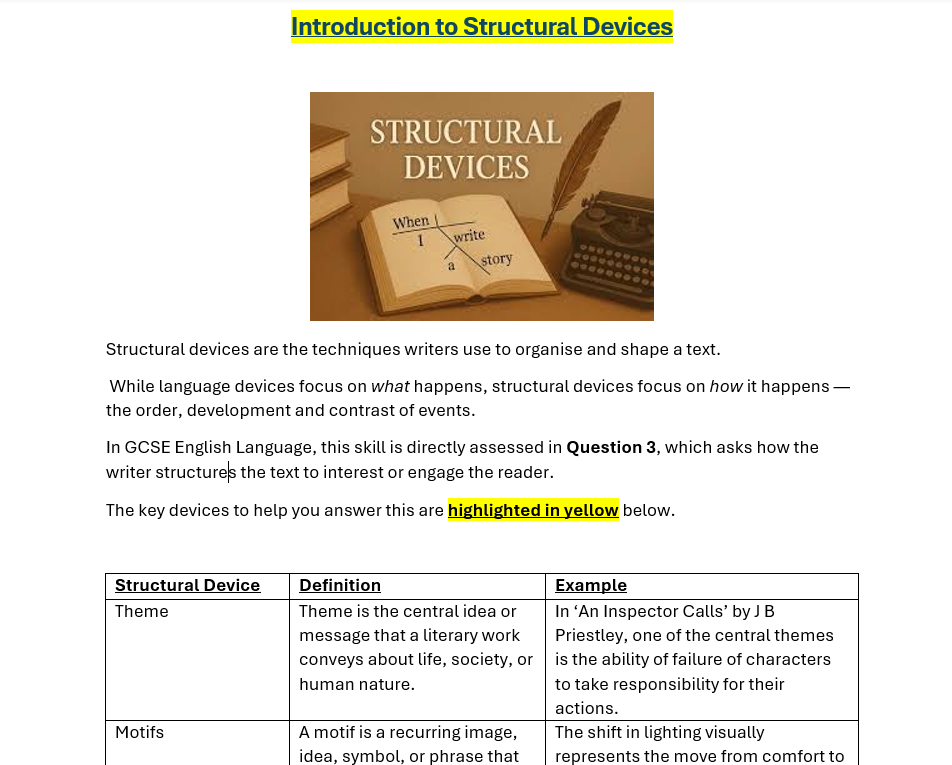
Firstly, I asked it to generate a list of structural terms, definitions and examples, in order to help my students with Question 3 of the GCSE English Language curriculum. This is arguably the most difficult question across the entire GCSE.
Having found the structural terms that AI generated to be too generic, I went through and read the mark schemes of every language paper ever published to build up a wider range of structural terms, before repeating the prompt. For any examples or definitions I wasn’t happy with, I either re-prompted AI or went in and changed the response manually.
The final table attached is the most extensive list of structural terms I know of.
As the Examiner’s Reports point out, it is far more important that students comment on the effects of these methods; however, in my experience, learning the methods by rote is a useful starting point.
No results match your search. Try removing a few filters.